Learning noisy quantum dynamics and discovering error-correction schemes
2023 - present · Stanford LINQS
Quantum error correction is how fragile quantum bits become reliable computers: information is spread across many physical qubits so that errors can be detected and undone. But the codes we use today were largely designed by hand, for idealized, textbook noise. Real devices are messier — their noise is structured, correlated, and changes under the periodic drives (Floquet dynamics) used to control them.
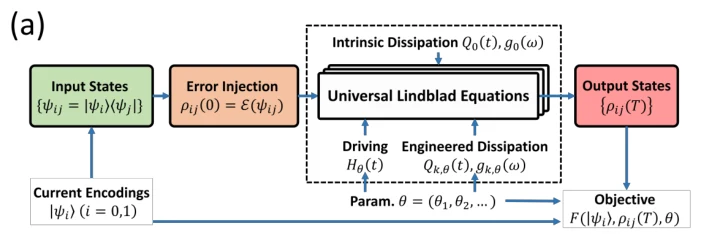
This project builds a numerical framework that first learns the actual noisy dynamics of driven quantum hardware from measured data, and then uses that learned model to automatically discover error-correction codes and quantum sensing schemes matched to the hardware as it really is, rather than as we wish it were. The aim is a design loop where the machine proposes, evaluates, and refines encodings against the device's true noise — a step toward error correction that is co-designed with the hardware. Results are in preparation.