Bayesian-filter qubit readout
2020 - 2021
Reading out a superconducting qubit means listening to a faint microwave tone for a few hundred nanoseconds and deciding: ground or excited? The standard recipe integrates the noisy signal with fixed weights and compares the result to a threshold. That works — until the qubit decays in the middle of the measurement, which is exactly what happens to short-lived qubits. For these T1-limited devices, the integrated signal lands between the two clouds and the assignment goes wrong.
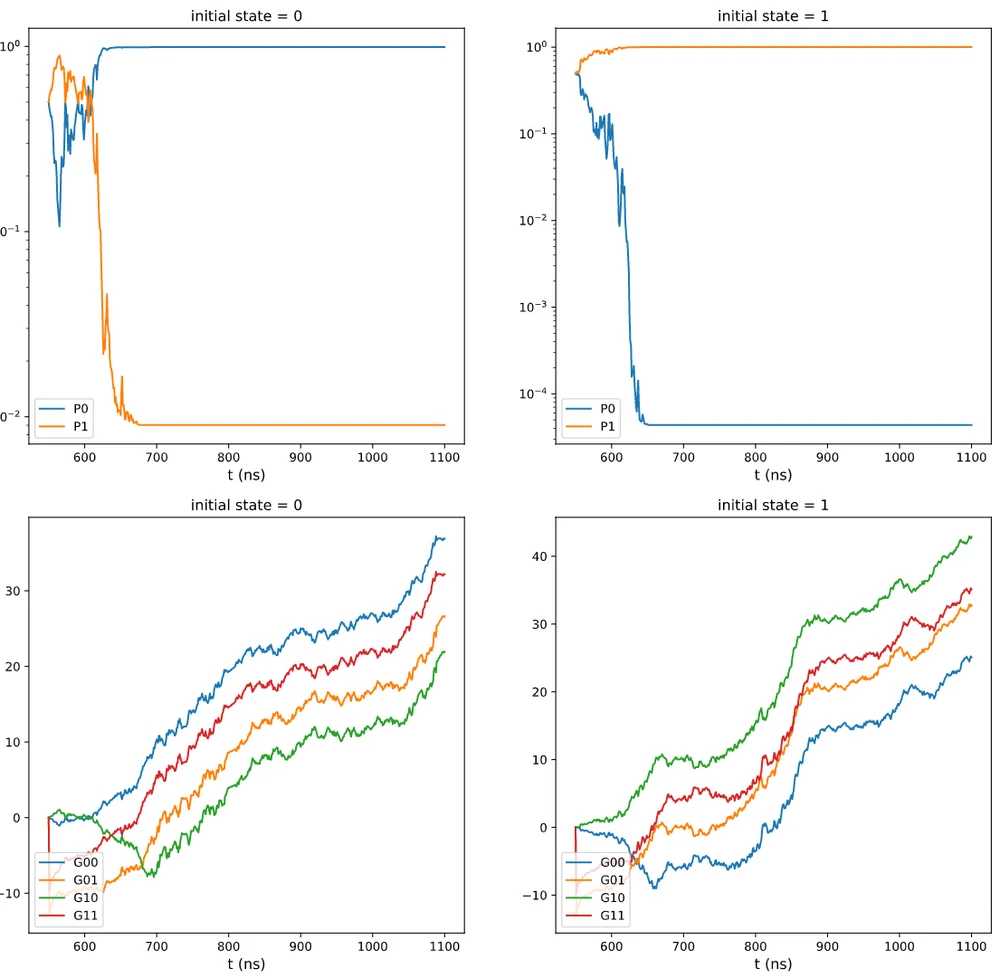
This project treats readout as a real-time inference problem instead. The full measurement chain — the resonator dynamics conditioned on the qubit state, the amplifier chain, and the noise — is modeled as a set of stochastic differential equations, and a Bayesian filter runs over the raw record, updating the probability of each qubit state nanosecond by nanosecond. A decay event mid-record is no longer a failure mode: the filter watches the evidence flip and tracks it.
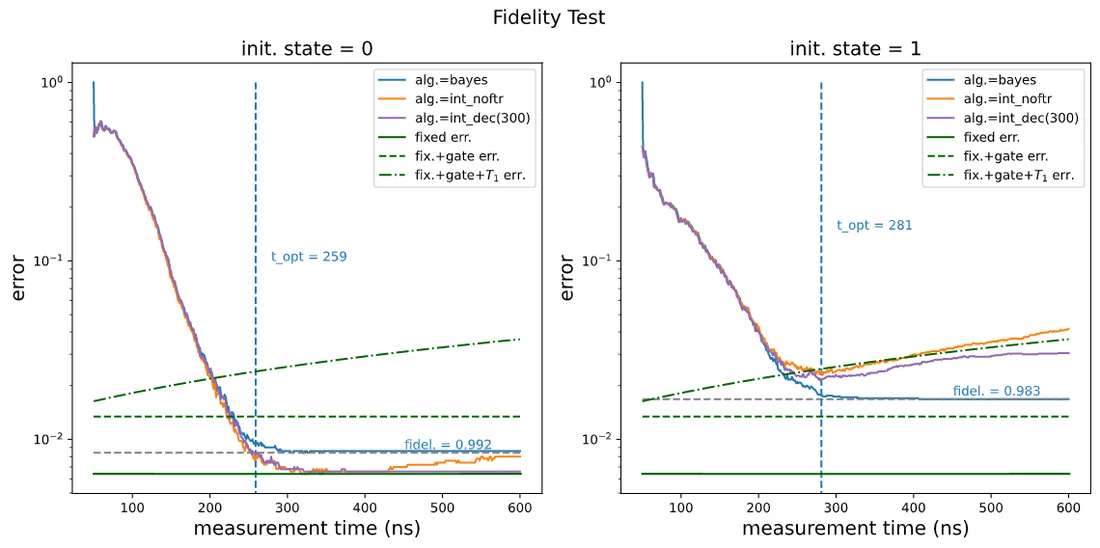
On experimental data the filter reached single-shot fidelities of 0.992 and 0.983 for the two initial states, beating boxcar integration precisely in the regime where qubit decay dominates — and it keeps improving with longer records where integration saturates or gets worse. It requires no hardware changes: it runs as pure post-processing on the same IQ records the experiment already collects.